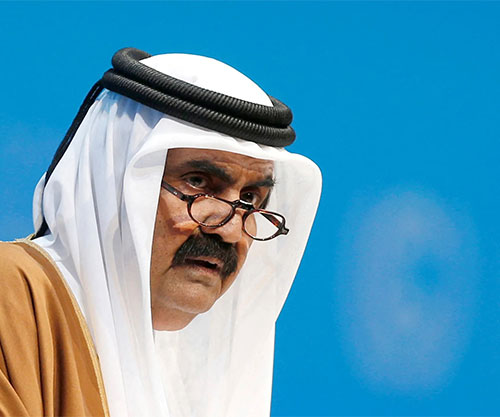





Qatar’s Father Emir Sheikh Hamad Bin Khalifa Al Thani died Saturday at the age of 74. Qatar announced a four-day period of public mourning starting Sunday, with work suspended at government agencies and public bodies and flags to be lowered to half-mast.
Sheikh Hamad, who ruled Qatar from 1995 to 2013, was a key architect of the energy-rich country’s development. During his 18-year rule, Sheikh Hamad reshaped the energy-rich country’s domestic and global footprint.
Sheikh Hamad’s economic legacy helped transform Qatar from a small Gulf economy to a major and influential player in global energy and investment markets. His major achievements include:
- The development of the North Field, the world’s largest natural gas field. Data from Qatar’s Amiri Diwan reflect the scale of the transformation witnessed by the energy sector, as the added value of the hydrocarbons sector rose from about $3bn to about $110.4bn during Sheikh Hamad’s rule.
- World Bank data cited by Bloomberg showed Qatar’s economy grew more than twentyfold during Sheikh Hamad’s reign, with gross domestic product (GDP) rising from about $8bn in 1995 to about $199 billion in 2013.
- In 2021, Qatar established the Supreme Council for Economic Affairs and Investment under the Chairmanship of Sheikh Hamad who implemented a policy based on allocating part of the energy revenues to long-term investment. Qatar’s investment policies expanded to cover almost every continent - from investments in football clubs, to global economic institutions, to London’s Shard skyscraper, among others. The authority’s assets are now estimated at more than $500bn, according to the Sovereign Wealth Fund Institute, making it one of the world’s largest government investors.
- During Sheikh Hamad’s reign, Qatar became one of the countries with the highest GDP per capita in the world, according to the World Bank and the IMF. It exceeded $90,000 in terms of purchasing power parity, as it expanded spending on housing, education and health and recorded a steep decline in unemployment rates to very low levels.
- One of the first development decisions after Sheikh Hamad assumed power was the establishment of the Qatar Foundation for Education, Science and Community Development in August 1995 to serve as the main arm for investment in education, scientific research and innovation. The country later attracted international universities including Georgetown, Texas A&M and Carnegie Mellon as part of a strategy to prepare for the post-oil and gas phase.
- The health sector also saw significant expansion through the development of Hamad Medical Corporation and the establishment of new hospitals and specialised centres as part of efforts to improve the quality of public services and keep pace with population growth.
- Gas revenues during Sheikh Hamad’s rule were not limited to financing Qatar’s budget, but were also used for massive infrastructure investments. That period saw the launch of projects such as Hamad International Airport, Hamad Port, Lusail City and modern road networks, alongside projects that later formed the foundation of the Doha Metro.
- Doha moved from a small Gulf city into a global urban hub, providing the foundation that enabled Qatar to become the first Arab and Middle Eastern country to host the FIFA World Cup in 2022. After the country won the right to host the major football tournament, its infrastructure and construction sector witnessed a major boom as the government approved huge spending plans exceeding $200bn in infrastructure, including roads, stadiums, railway lines and the construction of a new airport and port.
- In 2008, the state launched Qatar National Vision 2030, a strategic plan aimed at building a knowledge-based economy with the goal of ensuring continued prosperity for future generations. This vision, which continues to serve as the governing framework for economic policies, reflects a direction that began under Sheikh Hamad based on transforming natural wealth into a foundation for sustainable development.
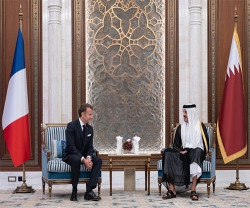
Sources: Al Jazeera; Qatar’s Amiri Diwan; World Bank/Bloomberg; Sovereign Wealth Fund Institute; Photo © Amiri Diwan/Al Jazeera