




Pakistan and Türkiye discussed expanded cooperation in advanced defense technologies, including unmanned aerial systems and aerospace innovation, Pakistan’s military recently said, as the two allies deepen strategic coordination shaped increasingly by the demands of modern warfare.
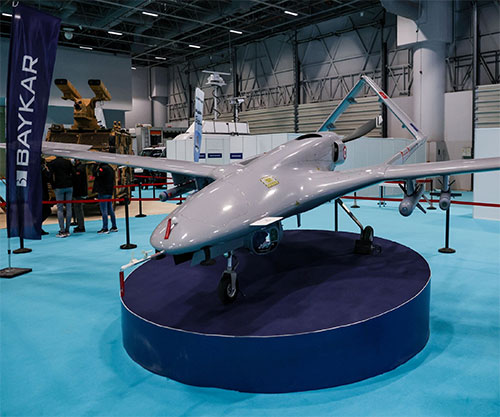
The announcement came after Pakistan Air Force (PAF) Chief Air Chief Marshal Zaheer Ahmed Baber Sidhu held meetings in Türkiye last month with the Turkish Air Force Commander, Defense Minister and senior executives of Turkish drone manufacturer Baykar Technologies, according to a statement by Pakistan’s Inter-Services Public Relations (ISPR).
The engagements reflect growing defense collaboration between the two countries at a time when militaries around the world are investing heavily in drones, electronic warfare, cyber capabilities and integrated multi-domain operations combining air, land and digital warfare systems.
“Chief of the Air Staff met with Mr. Selcuk Bayraktar, Chief Technology Officer of Baykar Technologies,” ISPR said.
“The interaction focused on advancements in aerospace innovation, unmanned aerial systems and emerging technologies, reflecting the shared vision of both sides to pursue greater collaboration in next-generation defense technologies.”
Pakistan has increasingly emphasized that future conflicts will be shaped by unmanned systems, artificial intelligence, cyber warfare and beyond-visual-range combat capabilities, particularly after last year’s conflict with India.
Earlier last month, the Pakistani Air Chief said the country’s Armed Forces had carried out a “full-spectrum, multi-domain operation” during the May 2025 fighting with India, claiming the campaign combined cyber offensives, drones, hypersonic weapons and long-range strike systems to degrade India’s military network.
“What the world witnessed in May 2025 was not achieved overnight but acquired through our transformative modernization undertaken within the past four to five years,” Sidhu said.
Pakistan says its Air Force shot down multiple Indian fighter jets during the conflict, including French-made Rafales, and has since highlighted the role of network-centric warfare and integrated battlefield coordination in the confrontation.
According to the ISPR statement, Sidhu’s meetings in Türkiye also focused on enhancing interoperability through joint exercises, training programs and professional exchanges.
The Turkish Air Force Commander appreciated Pakistan’s support in training Turkish pilots, the statement added, highlighting an important aspect of military cooperation between the two countries.
In a separate meeting, Sidhu also held talks with Turkish Defense Minister Yasar Guler on expanding collaboration in training, capacity building and aerospace-related fields.
ISPR described the engagements as reflecting the “growing strategic convergence” between Pakistan and Türkiye in defense and emerging technologies.