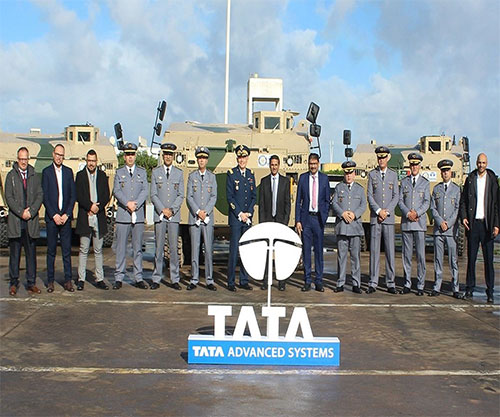





On December 24, 2025, the Royal Moroccan Army received the first batch of Wheeled Armoured Platform 8×8 vehicles, marking a pivotal shift in the North African nation’s defence procurement strategy. These vehicles, commonly known as the WhAP 8×8, arrived following a rapid industrial ramp-up at a newly established manufacturing facility in the Berrechid region, near Casablanca.
Developed through a collaboration between India’s Tata Advanced Systems Limited, or TASL, and the Indian Defence Research and Development Organisation, referred to as DRDO, the platform represents the first major venture of an Indian private defence company into African manufacturing, Military Africa reported
The delivery serves as the initial fulfilment of an agreement signed in late 2024, with serial production beginning in September 2025. This contract aims to provide the Royal Moroccan Army with a fleet of 150 units over three years.
Beyond a simple acquisition, the program emphasises a long-term industrial partnership that focuses on domestic manufacturing and the adaptation of the platform to meet the specific operational requirements of the Moroccan Armed Forces.
The manufacturing plant in Berrechid is a cornerstone of this partnership. Covering approximately 20,000 square meters, the site now stands as the largest defence manufacturing facility in Morocco. The facility reached operational status in September 2025, a notable three months ahead of its original schedule.
During the inauguration, which featured the Indian Defence Minister Rajnath Singh and his Moroccan counterpart Abdelatif Loudyi, officials noted the plant’s role in creating a local network of engineers, technicians, and suppliers.
Current production metrics indicate that around one-third of the vehicle’s components are manufactured domestically within Morocco. Plans are currently in place to raise this local value addition to 50 per cent during subsequent production runs.
By establishing “Tata Advanced Systems Morocco,” the program transforms the Kingdom into a regional production hub, potentially serving as a gateway for the WhAP 8×8 into the broader African market.
The WhAP 8×8 is designed as a modular combat vehicle that balances protection, lethality, and mobility across varied terrains. At its core, the platform utilises a 600-horsepower turbocharged diesel engine. The vehicle employs a fully automatic transmission with a retarder and a cooling system driven by hydraulic motors. To reduce the platform’s thermal signature, the design includes advanced exhaust gas dilution technologies.
Mobility is maintained through an 8×8 wheel configuration set on a hydropneumatic suspension system with a double wishbone arrangement. This setup allows for two distinct modes: a high-speed mode for standard road operations and a low-speed mode to maximise traction on soft or uneven ground. The first two axles are steerable, which reduces the turning radius to approximately 19 meters, a vital feature for navigating restricted urban or mountainous paths.
For amphibious operations, the WhAP 8×8 incorporates a common platform design that includes twin hydrojets in the rear for propulsion in water. It can achieve speeds of up to 100 kilometres per hour on roads and 10 kilometres per hour in aquatic environments. The vehicle also features a Central Tire Inflation System, or CTIS, and run-flat tyres, allowing the platform to continue moving even after suffering punctures or sudden pressure loss.
The vehicle is built around a survivable monocoque hull, a design where the external skin supports the primary loads of the structure. Protection levels follow the NATO Standardisation Agreement, or STANAG 4569.
Mine protection is an essential design priority given the prevalence of improvised explosive devices in modern conflict zones. The platform utilises a V-shaped hull and a reinforced floor to deflect blast energy away from the crew. Inside the vehicle, the seating arrangement further mitigates risk. Anti-blast seats are suspended from the roof rather than bolted to the floor, which helps absorb shock and reduces the likelihood of spinal injuries during a blast event. The troop compartment, which typically hosts six to eight soldiers, features outward-facing seats to allow personnel to monitor surroundings through individual periscopes and firing ports.
Potential armament configurations include 7.62mm or 12.7mm machine guns, as well as 30mm automatic cannons. (Military Africa; Photo: Handover of First WhAP 8x8 Vehicles to Royal Moroccan Army © Tata Advanced Systems)