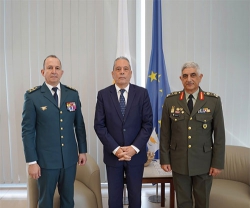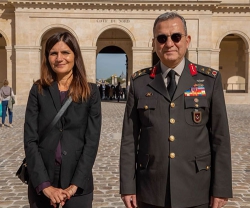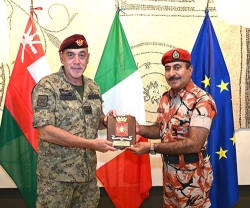
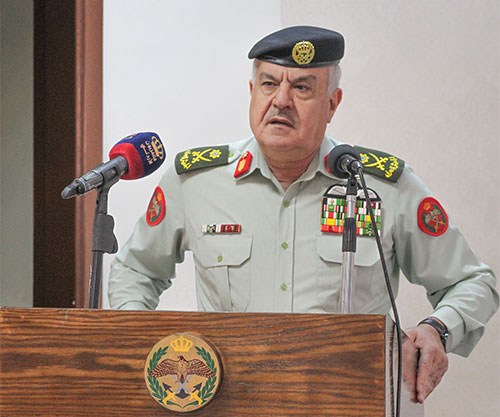





Chairman of the Jordanian Joint Chiefs of Staff Major General Yousef Huneiti on Sunday met with senior military officers at the General Command of the Jordan Armed Forces-Arab Army (JAF) on the occasion of Eid Al Adha (Festival of Sacrifice).
During the meeting, Huneiti conveyed the greetings of His Majesty King Abdullah, the Supreme Commander of the JAF, and HRH Crown Prince Hussein to all Armed Forces personnel on the occasion of the holy holiday, according to a JAF statement.
Huneiti reiterated that the Armed Forces will continue to carry out their duties with the highest levels of efficiency and professionalism, stressing the importance of maintaining full operational readiness across all formations and units to address any potential challenges.
He said that the JAF is pressing ahead with comprehensive modernisation and development programmes in line with Royal directives, aimed at enhancing military capabilities, improving operational performance and developing human resources in accordance with the latest standards, thereby strengthening the military’s defence and security roles.
The Army Chief also praised the dedication and commitment of JAF personnel across all areas of service, noting that the armed forces’ high level of readiness and efficiency reflects their professionalism and supports their mission of safeguarding the homeland, preserving its security and protecting its achievements.
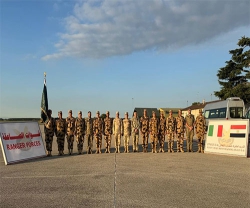
Meanwhile, for more than three decades, Jordan has maintained a prominent role in international peacekeeping efforts, deploying more than 142,000 personnel to conflict and disaster zones since 1989, providing medical care, protecting civilians and supporting stabilisation efforts in some of the world's most fragile environments.
In a statement to The Jordan Times, the Jordan Armed Forces-Arab Army (JAF) Media Directorate said that “Jordan joined the United Nations in 1955, establishing its international engagement within a multilateral legal and diplomatic framework, rooted in its commitment to United Nations action and broader humanitarian and international cooperation principles.”
JAF said that the Kingdom’s early contribution to regional stability predates its formal peacekeeping role, noting an initial deployment in 1961 to the Iraqi–Kuwaiti border aimed at preventing regional escalation.
The Kingdom formally entered United Nations peacekeeping operations in 1989 with the deployment of military observers to Angola, followed in 1992 by staff officers assigned to the United Nations Protection Force in the former Yugoslavia.
“Since then, Jordan’s participation has evolved into multidimensional deployments that include infantry battalions, Royal Engineering Corps units, Royal Medical Services teams, military observers and liaison officers serving across complex international environments,” the JAF said.
Over the decades, JAF personnel have served in a wide range of UN missions across Africa, Europe, Asia and beyond, including Kosovo, Sierra Leone, Liberia, Côte d’Ivoire, Burundi, the Democratic Republic of the Congo, Mali, Ethiopia and Eritrea, in addition to broader international and humanitarian deployments in Iraq, Afghanistan, Egypt, Pakistan, Indonesia, Turkey, Iran and the occupied Palestinian Territories.
A total of 142,334 personnel from the JAF have participated in peacekeeping missions in operational and logistical capacities, alongside 1,571 military observers and 308 female personnel, serving in more than 38 countries and supporting up to 15 missions simultaneously, according to the statement.
JAF said that a defining aspect of Jordan’s peacekeeping role has been its medical and humanitarian contribution, stressing that Jordanian field hospitals, classified as Level 1 and Level 2 facilities, were recognised for their efficiency and ability to operate in high-risk, resource-constrained environments.
“Jordanian medical teams have treated more than four million patients in conflict zones and disaster-affected areas, delivering emergency care, surgeries and primary healthcare services in situations where local systems have been severely weakened or overwhelmed.”
JAF added that this medical role has become a defining part of Jordan’s international identity, often described as “medical diplomacy”, combining humanitarian service with operational presence in crisis zones.
Jordanian medical and relief units have also been deployed to countries affected by conflict and natural disasters, including Pakistan, Turkey, Iran and Armenia.
Beyond healthcare, Jordanian peacekeepers have also carried out a wide range of operational and humanitarian duties under UN mandates, including the protection of civilians and refugee camps, securing humanitarian corridors and aid convoys, supporting international organisations, and assisting in the distribution of relief assistance.
Engineering units have also played a key role in road and bridge rehabilitation, infrastructure restoration, mine clearance and explosive hazard removal, JAF said, adding that operational units have monitored ceasefire agreements, conducted patrols, operated checkpoints and supported confidence-building efforts between conflicting parties.
JAF said that peacekeeping contributors are selected based on widely recognised operational and institutional criteria, including strong international reputation, adherence to neutrality and impartiality, high readiness for deployment, compatibility with United Nations operational standards, and acceptance by host parties under UN mandates.
It also stressed that its peacekeeping operations are conducted under strict principles of neutrality and impartiality, ensuring that assistance is provided to affected populations without discrimination based on ethnicity, religion or political affiliation, adding that these factors have contributed to Jordan’s repeated selection as a trusted troop-contributing country in UN peacekeeping operations.
Furthermore, JAF noted that participation in peacekeeping operations has significantly strengthened the operational readiness of the armed forces by exposing personnel to multinational environments and complex security challenges, including asymmetric warfare, urban operations and humanitarian crisis management.
Jordan’s peacekeeping contribution has also reinforced its diplomatic standing from a strategic perspective, JAF said. It noted that sustained engagement in United Nations missions has enhanced the Kingdom’s reputation as a reliable partner in collective security, strengthened its presence in international forums, and supported its foreign policy objectives through practical commitment to international law and multilateral cooperation.
Jordan’s peacekeeping record has also come at a high human cost. “Since the beginning of its participation in international missions, 44 Jordanian peacekeepers have been killed in the line of duty, while more than 375 personnel have been injured, including 30 who sustained severe wounds.”
“These sacrifices underscore the risks faced by Jordanian personnel deployed in complex and volatile environments under international mandates,” JAF said. It noted that Jordan’s peacekeepers continue to serve as representatives of the Kingdom’s commitment to international cooperation and humanitarian responsibility, with roles extending beyond traditional military functions into medical assistance, engineering support, civilian protection and peacebuilding efforts in some of the world’s most challenging environments. (Jordan Armed Forces (JAF); The Jordan Times; File Photo © JAF)