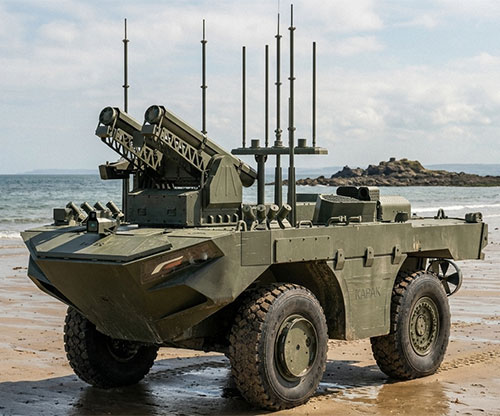





FNSS unveiled U-MAV, the Multi-Purpose Modular Unmanned Amphibious Vehicle at TEKNOFEST Mavi Vatan 2026, hosted by the Gölcük Naval Shipyard Command in Kocaeli from 20 to 23 August 2026..
İ-ZAHA designed to take the crew out of the first wave which is the highest-risk phase of any amphibious assault and to operate as part of a manned-unmanned team (MUM-T) with the Marine Assault Vehicles (MAV) already in service with the Turkish Naval Forces Command. It makes first contact with the opposing force’s shore defences ahead of the manned wave and keeps operators in a safe area.
The 8-ton platform transits from sea to shore without interruption, reaching 7 knots ashore and 70 km/h on land. Its modules can be changed in the field in approximately 40 minutes allowing ten different mission variants, from Fire Support and Mine Clearance to Electronic Warfare (EW) and Casualty Evacuation (CASEVAC).
FNSS CEO and Board Member Selim Baybaş said: “FNSS continues to grow its work and its R&D investment in unmanned and autonomous vehicle technologies. U-MAV brings together our engineering capability, the field success of the Marine Assault Vehicle (MAV) and our continuing R&D effort in a new-generation, heavy-class unmanned amphibious vehicle.”
Developed by FNSS, the U-MAV Multi-Purpose Modular Unmanned Amphibious Vehicle is a next-generation unmanned manoeuvre element, designed to operate in close coordination with Marine units equipped with the MAV/ZAHA amphibious assault vehicle.
The primary mission of U-MAV is to establish initial engagement with enemy coastal defences ahead of manned MAV/ZAHA elements, neutralise mines and obstacles in accordance with its configured payload, prepare the beach for manned MAV/ZAHA approach and landing, and provide support throughout all subsequent phases of the operation.
Autonomous, remote-controlled, or hybrid control modes keeping operators away from the line of contact throughout the mission, while the modular payload architecture, configurable with a range of mission systems, ensures that U-MAV contributes not only at initial contact, but actively across all phases: assault, support seizure and securing of the beachhead.
MISSION-SPECIFIC CAPABILITIES
- One of U-MAV’s most significant features is the interchangeability of mission payload modules on a common base platform, tailored to different operational profiles.
- U-MAV delivers seamless sea-to-shore mobility with a swimming speed of 7 knots and a road speed of 70 km/h. A combined 300-horsepower (hp) powerpack provides robust and reliable propulsion at an amphibious combat weight of 8 tonnes.
- U-MAV is designed to operate in autonomous, remote-controlled, or hybrid mode. An encrypted mesh network infrastructure, GNSS/INS navigation system, and IFF identification module work in concert to maintain command and control (C2) continuity throughout the operation.
- U-MAV is fully transportable by road, rail, and sea across all standard military transport assets. Where rapid airlift to distant operational areas is required, the platform is compatible with heavy-lift helicopters and strategic airlifters including the CH-47F Chinook, Mil Mi-26, C-130 Hercules, A400M, C-17 Globemaster, C-5 Galaxy, An-124, and Il-76, making it highly compatible with modern joint logistics frameworks.
- U-MAV's AI-enabled image processing architecture analyses camera feeds in real time on the vehicle's onboard mission computer, transmitting detection data rather than high-bandwidth video via radio link.
- U-MAV is the first unmanned vehicle to integrate Armor Integrity, Nurol Teknoloji’s structural integrity monitoring system, into its digital backbone. With no crew to assess a hit, the system replaces human judgement. Its sensors detect an impact’s location, direction and severity in real time, calculate the affected area’s remaining structural capacity, track latent damage that accumulates over time, and transmit to the operator and chain of command.