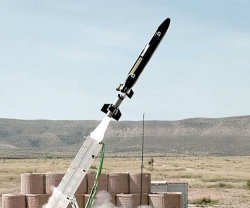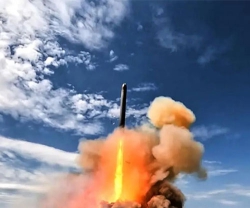
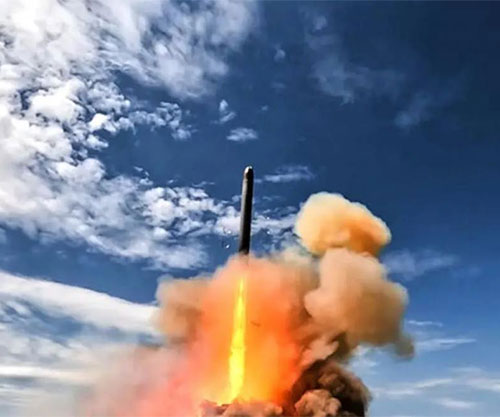





Russia successfully tested Tuesday its new Sarmat intercontinental ballistic missile system (ICBM), Commander of the Strategic Missile Forces Sergey Karakayev said in a report to Supreme Commander-in-Chief of the Russian Armed Forces Vladimir Putin.
President Putin observed the launch, which occurred at an unspecified location just days after his public assertion that the conflict in Ukraine is approaching its conclusion.
Putin stressed that Moscow continues to develop advanced strategic weapons systems unparalleled in the world as part of strengthening its defense and nuclear capabilities, Russian News Agency (TASS) reported.
With a range exceeding 35,000 kilometers, Sarmat is part of an ongoing initiative to modernize the Russia’s nuclear triad and will be put on combat duty by the end of this year.
“The Sarmat will indeed be deployed on combat duty by the end of this year,” Putin said.
“The missile can move not only on a ballistic but also on a suborbital trajectory, which allows for a range of over 35,000 km while doubling its accuracy and the ability to penetrate all existing and future missile defense systems,” Putin noted.
The Russian President emphasised that this is “the most powerful package system in the world. The total yield of the delivered warhead is more than four times greater than that of any existing, most powerful Western equivalent.'”
The heavy ICBM, referred to as “Satan II” by NATO, is scheduled to enter active combat service by the end of the year according to Russian officials.
Designed to replace the Soviet-era Voyevoda, the Sarmat is capable of carrying a 10-ton payload and reaching targets over 21,700 miles away through suborbital flight.
Putin highlighted that the Sarmat features higher precision than its predecessor and possesses the capability to bypass existing and prospective missile defense systems. The development of this weapon began in 2011 and is part of a broader suite of advanced armaments including the Avangard hypersonic glide vehicle and the Oreshnik intermediate-range missile.
“We were forced to consider ensuring our strategic security in the face of the new reality and the need to maintain a strategic balance of power and parity,” said Putin.
The test follows the expiration of the final nuclear arms pact between the United States and Russia in February 2026. This expiration has left the world's two largest atomic arsenals without formal caps for the first time in more than 50 years, sparking concerns regarding an unregulated arms race.
Currently, the U.S. and Russia maintain approximately 4,300 and 3,700 nuclear warheads respectively, according to data from the Federation of American Scientists. (TASS; Agencies; Photo © Russian Defense Ministry Press Service/AP)