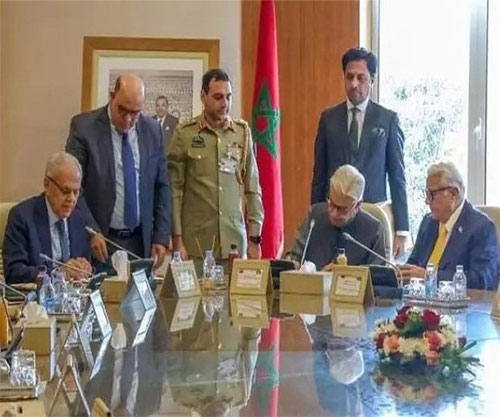





Pakistan and Morocco signed a Memorandum of Understanding (MoU) earlier this year, to formalize and expand their bilateral defense and military cooperation, and start joint manufacturing of advanced electronics and optronics.
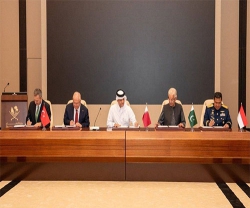
Pakistani Federal Defense Minister Khawaja Muhammad Asif and Moroccan Minister Delegate Abdellatif Loudyi signed the Memorandum of Understanding (MoU) in Rabat, Morocco on January 13, 2026 (photo), Moroccan media reported.
The agreement establishes an institutional framework for permanent military ties, with a focus on technology transfer and industrial joint ventures. Key officials present included the Inspector General of the Royal Armed Forces, General Mohamed Berriz, and the Pakistani Ambassador to Rabat.
The deal follows two years of high-level negotiations at international defense exhibitions. Initial discussions began at the IDEAS fair in Karachi in November 2024 and continued through IDEX 2025 in Abu Dhabi. These meetings involved the leadership of Shibli Electronics and Morocco’s National Defense Administration, including Brigadier General Fouad Moumen of the Moroccan General Staff.
A primary result of this pact is the construction of a military manufacturing facility in Morocco by Shibli Electronics, a private Pakistani firm specializing in thermal imaging. Shibli is finalizing an investment with a Moroccan partner to build an industrial unit that will produce night vision systems and thermal sensors. The project includes a complete technology transfer and training for local Moroccan engineers to operate the facility independently.
The new facility will focus on high-performance hardware that is already familiar to Moroccan security forces. The Royal Gendarmerie currently uses Shibli’s Tarsier Mini 50 thermal rifle scopes and SKUA thermal binoculars for border surveillance and patrol. The Tarsier Mini 50 is an uncooled thermal scope weighing less than 700 grams, designed for rapid target acquisition at ranges up to 2,800 meters for vehicles.
Production will also likely include the SKUA range of binoculars, which provide long-range detection in harsh conditions such as smoke or fog. By localizing this production, Morocco avoids the logistical delays and costs of direct importation from Islamabad, Pakistan. The facility serves a dual role by supplying the Royal Armed Forces (FAR) and positioning Morocco as a supplier for the wider African defense market.
This industrial move aligns with Morocco’s 2026 defense budget, which increased by 17.8 percent. Rabat is pursuing a strategy of “defense independence” to reduce its 90 percent reliance on imports. The government now mandates 30 percent local subcontracting for new defense projects to build domestic industrial clusters.
The Shibli investment follows a similar model used by India’s Tata Advanced Systems Limited (TASL). In September 2025, TASL opened a plant in Berrechid to assemble 8×8 Wheeled Armoured Platforms (WhAP) for the Moroccan military. These partnerships show Morocco’s shift away from simple procurement toward co-production and technology ownership. Beyond hardware, the MoU covers cybersecurity, military health, and joint exercises.
Morocco and Pakistan conducted counter-terrorism drills in late 2025, and the new agreement establishes a joint follow-up mechanism to coordinate these activities. This structured cooperation allows both nations to diversify their strategic ties while Pakistan secures a foothold in the North African defense sector.
The next stage of the partnership involves the arrival of Pakistani technical teams in Morocco to begin staff training. Officials expect the Shibli manufacturing unit to reach initial operational capacity by late 2026.