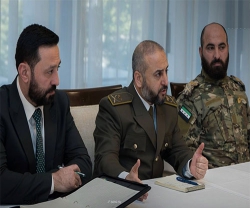
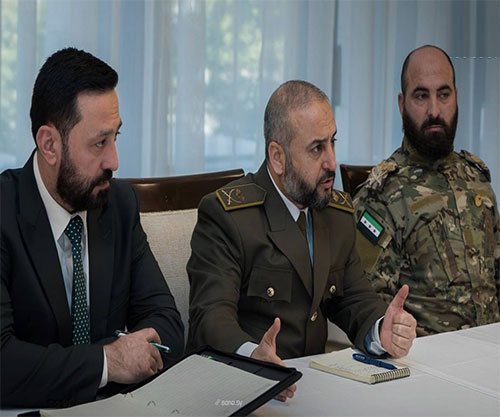





The Syrian Minister of Defense Major General Murhaf Abu Qasra met Monday with Chairman of the Jordanian Joint Chiefs of Staff Major General Majdi al-Harasis and Director of Jordan’s General Intelligence Directorate Major General Ahmad Husni.
The high-level meeting took place in the presence of Chief of the General Staff Major General Ali al-Naasan and Head of the General Intelligence Service Major General Abdul Qader Tahan.
During the meeting, the two sides discussed a number of issues of mutual interest to both countries, focusing on strengthening security and defense cooperation.
The talks coincided with the conclusion of the third session of the Syrian-Jordanian Higher Coordination Council held earlier today in Damascus, during which both nations signed eight memorandums of understanding, two executive programs, and a cooperation protocol spanning multiple strategic sectors, the Syrian Arab News Agency (SANA) reported.
The Council reaffirmed the two countries’ determination to further strengthen their historic fraternal relations, maintain coordination and consultations, expand sectoral cooperation, and deepen their comprehensive strategic partnership, in line with the visions and directives of Syrian President Ahmad al-Sharaa and Jordan’s King Abdullah II, and in a manner that serves the mutual interests of both countries and their peoples.
The Council reviewed progress in implementing the outcomes of its second session, held in the Jordanian capital, Amman, on April 11–12, 2026, as well as developments in bilateral relations across various fields, including intensified official visits, meetings, and technical and sectoral consultations.
It expressed satisfaction with the level of coordination between the two countries and their shared commitment to translating understandings into practical programs and projects that promote economic and developmental integration.
During its third session, the Council discussed existing and prospective cooperation across a wide range of sectors, including political and diplomatic coordination; economy, trade and investment; water; energy; agriculture and food security; transport and civil aviation; customs; the digital economy and information technology; tourism; justice and education.
The session also covered health; culture; higher education; religious affairs; sports and youth; local administration and the environment; finance; public works and housing; social affairs; labor; media; emergency and disaster management; border crossing development; joint economic cities; capacity building; institutional development; public administration; defense; security; and border security.
The Council also reviewed the latest regional and international developments, emphasizing the importance of strengthening regional security and stability, supporting efforts to de-escalate tensions, and addressing common challenges.
At the conclusion of the third session of the Syrian-Jordanian Higher Coordination Council, both countries signed eight Memoranda of Understanding, two Executive Programs and a Cooperation Protocol covering food security, agriculture and the environment, investment, water, railway transport, youth, public administration and civil service, civil aviation, higher education and scientific research, and educational cooperation.
This was followed by a joint press conference at Tishreen Palace by Syrian Foreign Minister Asaad Hassan al-Shaibani and Jordanian Deputy Prime Minister and Foreign Minister Ayman Safadi.
The two sides agreed to hold the Council’s fourth session in the Jordanian capital, Amman, on a date to be determined later.
They also agreed to continue monitoring the implementation of the Council’s outcomes through their respective foreign ministries and relevant sectoral authorities. (SANA; Photo © SANA)