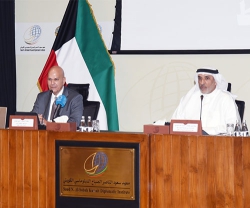
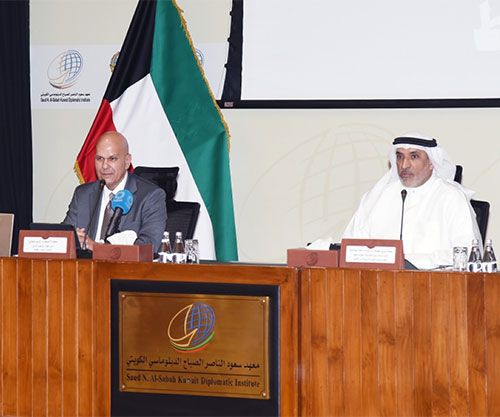





Ambassador Karim Haggag, Director of the Stockholm International Peace Research Institute (SIPRI), delivered a lecture at the Saud Al-Nasser Al-Sabah Diplomatic Institute in Kuwait on “Armament and Security Trends in the Middle East,” addressing major shifts in global and regional security and the growing challenges posed by emerging military technologies.
Haggag opened his lecture with an overview of the international security landscape, noting that global military spending was estimated to have risen for the 11th consecutive year in 2025, reaching $2.9 trillion, equivalent to 2.5 percent of global GDP and the highest level ever recorded.
He attributed the increase to the return of large-scale conventional warfare between technologically advanced states, citing the Russia-Ukraine war and the conflict in the Middle East, alongside growing strains within US-led alliances and intensifying security competition among major powers.
also highlighted what he described as the erosion of key pillars of the international order, including the weakening of arms-control mechanisms, the declining role of international law, particularly international humanitarian law, growing concerns over supply chains and critical minerals, and the reduced effectiveness of multilateral frameworks, Kuwait News Agency (KUNA) reported.
Changing Nature of Warfare
Haggag discussed the rapid technological transformation of modern warfare, pointing to the expanding use of missiles and drones for a range of missions, including precision strikes against targets deep inside enemy territory.
He also highlighted the growing role of artificial intelligence in military operations, ranging from autonomous weapon systems capable of selecting targets with limited or no human intervention to decision-support systems used in military planning, target identification, and information analysis.
Haggag also pointed to advances in conventional weapons that can produce effects approaching those traditionally associated with strategic weapons, alongside major changes in the economics of warfare and military production.
According to him, these developments are transforming security and military interactions by weakening some legal and strategic constraints on the use of force, accelerating the pace and complexity of military engagements, and creating multiple pathways for escalation and increased military risks. The distinction between civilian and military spheres is also becoming increasingly blurred, as is the traditional divide between conventional and nuclear domains, while the balance between offensive and defensive capabilities is becoming more difficult to maintain.
Security, Armament Trends
Turning to the Middle East, Haggag outlined a series of major shifts in the region’s security environment, including the return of direct armed conflict between states, citing the confrontation involving Iran, Israel and the United States. He said regional conflicts were increasingly taking on existential dimensions, particularly in relation to Iran and Palestine, while the US role in the region was also changing significantly amid its broader strategic competition with China and shifts in domestic American politics.
Haggag further highlighted the growing interconnectedness of regional conflict fronts, spanning Iran, the Gulf, Palestine, Lebanon, Iraq, Jordan, Yemen, the Zionist entity and Syria. At the same time, military spending in the Middle East has continued to rise in both scale and sophistication, reaching an estimated $218 billion in 2025, representing a 36 percent increase over the past decade.
According to Haggag, the region is witnessing growing arms-race dynamics, the emergence of new forms of deterrence and pre-emptive military doctrines, and faster escalation of armed conflicts.
Haggag said achieving regional stability requires a comprehensive approach based on controlling arms races, developing a clear understanding of threat perceptions and the red lines of adversaries, reducing incentives for pre-emptive strategies, and establishing reliable mechanisms for conflict management and confidence-building.
N.B. A former Egyptian diplomat with over 25 years focusing on Middle East security and arms control, Haggag has also worked as a Professor of Practice at the American University in Cairo and a non-resident fellow at Harvard’s Belfer Center.
Haggah took office on September 8, 2025, as the 10th Director of SIPRI, succeeding Dan Smith. (KUNA; SIPRI; Photo © KUNA)