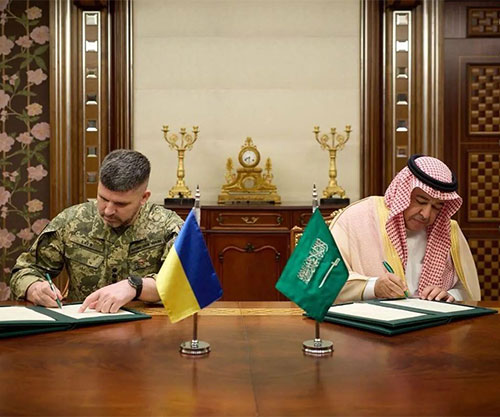





The Saudi Ministry of Defense and its Ukrainian counterpart signed Saturday a Memorandum of Understanding related to defense procurement arrangements in Jeddah.
Saudi Arabia’s Assistant Minister of Defense for Executive Affairs Dr. Khaled Al-Biyari and Chief of the General Staff of the Armed Forces of Ukraine Lieutenant General Andrii Hnatov signed the agreement, the Saudi Press Agency (SPA) said in a brief statement.
President Volodymyr Zelenskyy of Ukraine arrived in Jeddah on Friday. He was seen off at King Abdulaziz International Airport Saturday by Makkah Region Deputy Governor Prince Saud bin Mishaal bin Abdulaziz and other senior officials.
In an address to members of the United Kingdom Parliament in London last Tuesday, Zelenskyy said 201 Ukrainian anti-drone experts are in the Gulf region and another 34 “are ready to deploy.”
“These are military experts, experts who know how to help, how to defend against Shahed drones,” Zelenskyy said in his speech, referring to the Iranian-designed “kamikaze” drones that Russia has been using in its war against Ukraine since 2022.
“Our teams are already in the Emirates, Qatar, Saudi Arabia, and on the way to Kuwait. We are working with several other countries - agreements are already in place,” he added, Al Jazeera news channel reported.
Earlier this month, the Ukrainian President said military teams had been sent to several Gulf states and Jordan.
Ukraine has moved on from making sea and aerial drones to producing interceptors that target drones, he said, adding that Ukraine is capable of producing at least 2,000 interceptors per day - half of which are required for its own defence and the remainder available for use by Kyiv’s allies.
“If a Shahed needs to be stopped in the Emirates - we can do it. If it needs to be stopped in Europe or the United Kingdom - we can do it. It is a matter of technology, investment, and cooperation,” he said.
Meantime, Wild Hornets of Ukraine has said that Middle East clients have expressed interest in its interceptors, but that it is not directly negotiating any export contracts before getting a green light from Ukraine’s government.
Interceptors like the STING are a low-cost alternative to multi-million-dollar U.S. Patriot air-defense missiles, capable of swooping in on lumbering Russian-made versions of the Shahed with overpowering speed, Reuters reported.
The STING flies at up to 280 km (174 miles) per hour, supported by a 360-degree antenna and a maximum flight range of around 37 km - a combination allowing it to chase down drones from a distance before crashing into them with explosives.
The STING has downed more than 3,000 Russian Shaheds since entering regular service in June 2025, the company said. More than 10,000 units roll off the production line monthly.
They cost around $2,000 or less - compared to the Shahed’s $20,000-$50,000 - and are purchased through the government’s defense-tech incubator or prominent private charities.
A second-generation model has already been developed to fly even faster and target the jet-powered Shaheds which Russia is continuously developing, according to a company representative who asked not to be identified for security purposes.