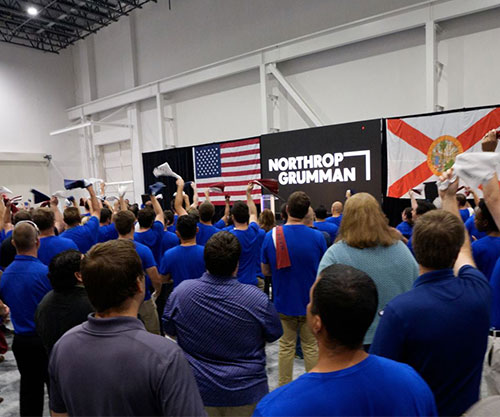





Northrop Grumman showcased its leading role in Florida’s aerospace and defense industry with an employee celebration at its Melbourne campus, home to a 5,000-strong workforce and 2 million square feet of facilities space. The event was held inside the high-bay of the company’s newest facility, surrounded by local, state and federal leaders.
“We’re continuing to grow in Florida, turning years of investment and experience into real capabilities our warfighters need. This facility reinforces Melbourne as the epicenter of sixth-generation aircraft,” said Tom Jones, Corporate Vice President and President, Northrop Grumman Aeronautics Systems.
“Most times, we host ribbon-cuttings when we open the doors to a new facility. In our world, we also celebrate by closing them, because our people are about to get to work on things in this facility that we can’t talk about. Between these walls in just a few months, we will have cutting-edge labs, and hundreds of skilled engineers coming together in a world-class facility. This is what momentum looks like,” Jones added.
The event spotlighted Melbourne’s expanding role in next-generation aircraft design and development, anchored by the new 300,000-square-foot engineering facility that reflects the site’s growth and expanding role in America’s defense industrial base. Featuring space for over 1,200 engineers and 17 secure laboratories dedicated to advanced aircraft design, the Melbourne site exemplifies Northrop Grumman’s commitment to building the workforce, technology and infrastructure required to deliver next-generation airpower. Together, these investments position Florida as a long-term hub for innovation, stability and opportunity in support of the nation’s most critical defense programs.
The event included remarks from Northrop Grumman’s Tom Jones; U.S. Rep. Mike Haridopolos (FL‑8); Florida Secretary of Commerce Alex Kelly; and Florida State Sen. Debbie Mayfield (District 19).
Northrop Grumman contributes to Florida’s economy through its nearly 8,000 employees and over 500 supplier partners, generating more than $10 billion in annual economic output, according to a recent study.
Last week, Northrop Grumman completed a key government-led critical design review for the E-2D Advanced Hawkeye’s Block II upgrade, clearing the way for integration and testing of the most significant platform upgrade in the program’s history. Northrop Grumman will immediately begin Block II integration and testing and is set to deliver Block II aircraft by the end of the decade.
Block II represents the most significant upgrade since E-2D’s development, dramatically improving situational awareness and crew efficiency while future-proofing the platform against evolving threats.
Using a modular open systems approach and commercial off-the-shelf products, Block II reduces costs and supports long-term fleet sustainment and modernization.
Northrop Grumman will integrate the Block II upgrade into the E-2D’s active production line for new aircraft and retrofit existing fleet aircraft, increasing upgrade capacity.
Janice Zilch, Vice President and Program Manager, E-2D Advanced Hawkeye, Northrop Grumman, commented: “Completing the Block II critical design review reflects the dedication and expertise of our team and partners. This upgrade strengthens the E-2D’s suite of capabilities, enhancing situational awareness, reducing crew workload and paving the way for future technology. We are continuing to deliver unmatched capability at speed to the U.S. Navy and our international partners.”
The E-2D Advanced Hawkeye is an airborne early warning command and control platform that is purpose-built for the airborne early warning and battle management mission. The E-2D program supports over 4,000 jobs at 411 companies across 40 U.S. states, significantly contributing to the resilience of the U.S. defense industrial base and American manufacturing.
E-2D is continuously modernized to stay ahead of threats, ensuring the joint force can see and sense when it matters most. The Block II Upgrade is comprised of a comprehensive overhaul of mission system software and hardware that will sustain its relevance well into the future.