
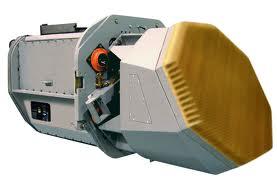





Raytheon delivered its 200th APG-79 Active Electronically Scanned Array (AESA) radar to Boeing for installation on U.S. Navy F/A-18E/F and EA-18G aircraft and the Royal Australian Air Force F/A-18F Super Hornet.
"As we celebrate our 200th APG-79 AESA delivery, it is also significant to note that the U.S. Navy has now flown Raytheon's AESA radars for more than 115,000 operational flight hours," said Fred Lanes, Business Development Executive for Raytheon's Tactical Airborne Systems business division. "Our service members have now received 200 critically needed, combat-proven radars. These milestones are a testament to how our AESA technology has revolutionized fighter combat capabilities and dramatically improved situationan awareness for aircrews."
The APG-79 AESA is in operation with more than a dozen U.S. Navy squadrons. Internationally, the Royal Australian Air Force has received its first five aircraft ahead of schedule, marking the delivery of the first foreign military sale of Super Hornets equipped with an APG-79 radar.
"The combat-proven Block II Super Hornet with its fully integrated APG-79 AESA radar is delivering unmatched capability for the U.S. Navy and the Royal Australian Air Force. It is also a core component of the EA-18G, which will deploy for the first time in 2010," said Kory Mathews, Boeing F/A-18 and EA-18 Programs Vice President.
In full rate production, the APG-79 is produced at Raytheon's Forest, Miss., facility. The Consolidated Manufacturing Center meets the domestic and international needs of radar production for platforms such as the F-15, F/A-18E/F, EA-18G and Global Hawk. The APG-79 is one of the most reliable radars available today, delivering 1000-1500 percent more uptime than mechanically scanned array radars, which results in lower life-cycle cost.
Raytheon Delivers 200th APG-79 Radar
26.07.2010 Aviation Space
Related articles
Kurt Amend Named Chief Executive of Raytheon Arabia
Raytheon Company announced that Kurt Amend will serve as Chief Executive of the Raytheon Arabia business unit.In his new role, Amend

Raytheon’s Kennedy Ranked Among Top US CEOs
Employer database and employment review site Glassdoor has named Kennedy to its 2017 Employees' Choice list of the 100 highest-rated
Raytheon Unveils Compact Multi-Spectral Targeting System
Raytheon Company is developing a smaller, lightweight version of its Multi-Spectral Targeting System™. The Compact MTS, a 12 inch
Small Diameter Bomb II Completes Wind Tunnel Tests
Raytheon Company and the U.S. Air Force completed a series of rigorous, high-speed wind tunnel tests for Small Diameter Bomb II™,
Raytheon to Offer DeepStrike® to US Army LRPF Program
The U.S. Army awarded Raytheon Company a $116.4 million contract to enter the technological maturation and risk reduction phase of the

Raytheon to Modernize US Army Strategic Software Systems
Raytheon Company has been awarded a contract valued up to $600 million for software support and sustainment to modernize missile
Latest news



Latest events
Langkawi International Maritime & Aerospace Exhibition (LIMA)
20 - 24 May 2025Langkawi - Malaysia
Paris Air Show
16 - 22 Jun 2025Paris Le Bourget - France
DefenPol China2025 - 7th Guangzhou International Defense & Police Exhibition & Summit
11 - 12 Jul 2025Nan Fung International Convention & Exhibition Center (NICEC) - China
IDEF 2025 Turkey - International Defence Industry Fair
22 - 27 Jul 2025Istanbul Expo Center - Turkey
Latest Issues
THE WORLD DEFENSE ALMANAC 2024